Last week, my friend M. and I decided to go exploring in some banksia woodland to the north of Charlotte's Vineyard in Ellenbrook. This is an area I have visited many times, but there's always something new and interesting to see. The weather couldn't have been better for a winter walk - clear blue skies, warm sunshine; no sign of the rain typical for this time of the year.
Our first find was an adult
Bobtail (Tiliqua rugosa) out sunning itself. It's not uncommon to spot baby bobtails making the best of the sometimes-patchy winter sunshine, but adults are not usually out and about in winter because they take longer to warm up. A cold slow adult is a dead adult if there are predators around. This adult scooted away as quickly as it could, while still appearing nonchalant. We had time to take a few photos before bobbie was under cover.
 |
| Bobtail (Tiliqua rugosa) in the sun |
Once we were in the banksia woodland proper, we found that the
Acacias (wattle) were flowering. Acacias in this part of the world are either small woody trees, or delicate open shrubby affairs, and in this case it was the latter. Masses of small yellow pom-pom flowers of
Acacia pulchella and
Acacia sessilis dotted the grey-green landscape.
 |
| Acacia pulchella (commonly called Prickly Moses) in flower |
 |
| A close-up of Acacia pulchella pom-poms |
The Acacias weren't the only flowers around. As we picked our way through the trees, down the hill towards the wetlands, we saw small soft-leaved Hibbertias growing in shrubby clumps, their yellow flowers almost the same shade and intensity as the Acacia blooms. We found
Hibbertia subvaginata and
Hibbertia hypericoides in flower. It seems that yellow is the colour of August!
 |
| Hibbertia subvaginata growing in a small clump (one plant) |
 |
| Close-up of Hibbertia subvaginata flowers and leaves |
Onward to the wetlands! It was dry enough underfoot to wonder why on earth these are called
wetlands, a question M. put to me during our meandering. Shouldn't there be ponds, lakes or a creek somewhere?
The area retains its
typical wetland vegetation of
Stout Paperbark (Melaleuca preissiana) and
Swamp Sheoak (Casuarina obesa) trees, with various sedges and other water-appreciating understorey plants, despite
not having had a decent winter's rain in thirty years. It will be interesting to see what it looks like in fifty years' time. The substrate is quick-draining sand, so even after a night of heavy downpours, we would have to get up early to see any water lying on the surface.
 |
| Wetland edge with Stout Paperbarks and Swamp Sheoaks, sedges and Hibbertias |
One particularly spectacular individual of Stout Paperbark was featured in an earlier blog - see
The Grandmother Tree.
About a kilometre further into the bushland, we found an area where some of the paperbarks had died. These are the big twisty trees in the centre and right of the photo below; they were Stout Paperbarks (
Melaleuca preissiana). The whole patch seemed to be suffering, perhaps from the lack of rain. However, I was heartened to see that
Holly-leaved Banksia (Banksia ilicifolia) were growing there, so this may be just a case of natural succession.
 |
| Dead Stout Paperbarks (Melaleuca preissiana) with new growth of Holly-leaved Banksia (Banksia ilicifolia) |
My friend M. found a
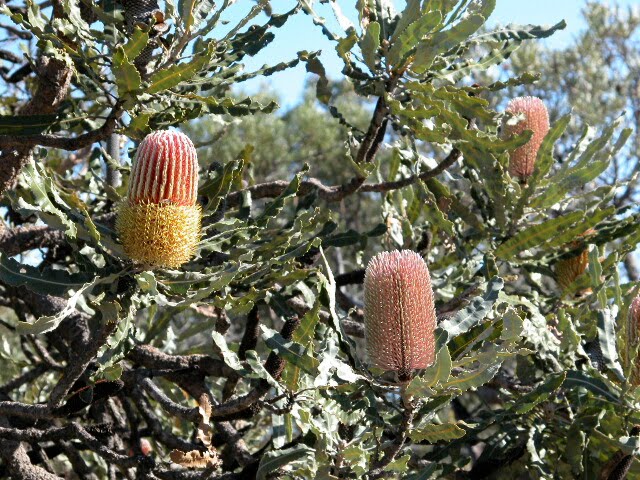
Swamp Banksia (Banksia littoralis) in flower, and took some photos of the flower cones. Guess what colour they are? She remarked that these and many other plants in the area are food for
Carnaby's Cockatoo. (Later, we even heard and saw some cockatoos flying around in the distance; so they do use the area.) We admired the beautiful foliage of this tree and its neighbours, glimmering silver and dark green as the breeze ruffled the leaves.
 |
| Swamp Banksia (Banksia littoralis) attracts birds and photographers! |
The effect of silver and green ruffling is best photographed with the sun behind you. Perhaps a photo doesn't really do it justice - video would be better!
 |
| Swamp Banksia (Banksia littoralis) in the breeze |
Eventually we decided it was time to go home. It took us an hour or so to walk to back to the car. Of course, there were still things to look at on the way; carnivorous plants (known as
sundews) which supplement the meagre soil nutrients by eating insects, weird bulbous fungi with cracked skins, and ancient cycads (
Macrozamia fraseri) with their lush green fronds.
 |
| An unknown (to me) species of sundew (Drosera sp.) growing in sand |
 |
| Fungi fruit, about the size of a golf ball (any mycologists out there want to identify this?) |
 |
| Macrozamia fraseri, a cycad native to Perth |
On arriving home, we found we had taken about a hundred photos, walked about 6km in a couple of hours, and discovered only three
kangaroo ticks on our persons at the end of the trip. The walk had also given us a good appetite for a very late lunch. A worthwhile day indeed!