Our Bushland Diary


Showing posts with label banksia. Show all posts

Saturday, May 15, 2010

Perfect weather for bushwalking

With the recent appearance of cooler temperatures (around 19 to 25 degrees Celsius during the day) it's suddenly become an absolutely perfect time to explore our local bushland.  We've had two guided bushwalks into the areas north of Charlottes Vineyard, on the mornings of Friday 14th and Saturday 15th May.  

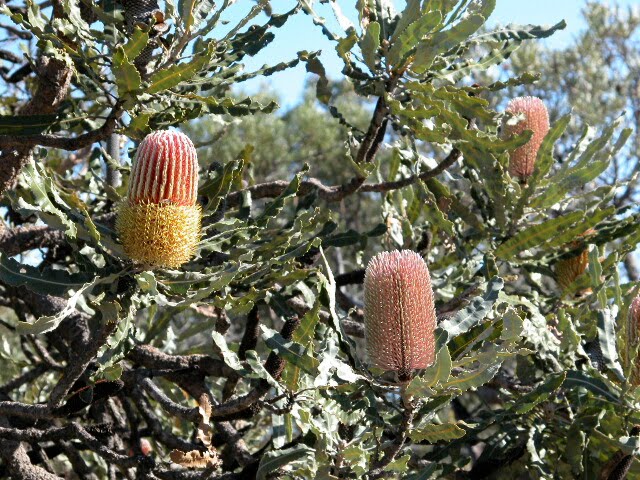
The Firewood Banksia (Banksia menziesii) is just starting to come into flower now, so some of the honeyeaters are visiting it to collect its nectar.  This tree also provides food (seeds and borer grubs) for the endangered Carnaby's Black-Cockatoo.


Friday 14th May - Wild Women's Walk
The group of intrepid walkers braved a cool morning to climb to the lookout and watch the sun rising over the hills through layers of fog.  Then we headed off to the north,  through banksias and WA Christmas trees, to visit one of Fat Bobbie's favourite spots - a huge old Stout Paperbark (Melaleuca preissiana) which has been nicknamed "the Grandmother tree".  This tree measures five metres around its base, and has a beautifully gnarled papery trunk marked by bushfires.  

Birds started to come out to call and forage as we picked our way through the trees to return to the hilltop.  We stopped to look at ancient cycads (Macrozamia riedlei) on the way.


Saturday 15th May - Family Bush Adventure
Not much fog on this morning, but plenty of animal tracks to look at!  The children found the tracks of Western Grey Kangaroos, Black-gloved Wallabies, Southern Brown Bandicoots and Common Bronzewing on their trek through the banksia woodland.  


(If we weren't so noisy, we may have seen a couple of these animals during our adventure.)  

We also stopped to admire a grove of small Pricklybark (Eucalyptus todtiana) growing in the sand.


One of the kids found a patch of sundews (Drosera sp.), and our resident botanist explained how these little plants feed on insects to supplement the low nitrogen levels of the soil.  Our trek took us along an old bush track through banksia woodland, and then through an old pine plantation to return to the lookout.

For future events, please check our listings above, as we will soon be adding more.


Sunday, November 1, 2009

world's biggest dugite and the Japanese hen

Ellenbrook is having a spell of cooler weather (11 to 24 degrees Celsius) and it’s a perfect time to go bushwalking.  So yesterday I headed off for a long stroll amongst the banksias and paperbarks.


At about 4pm I was carefully picking my way through an ephemeral wetland.  These kinds of wetlands have huge paperbark trees (typically Melaleuca preissiana) and a thick patchy understorey of shrubs and sedges.  Ephemeral wetlands in this part of Australia have water lying on the surface after rain in winter, and are dry most of the remainder of the year.  But the shrubs and trees are great places to see animals.  It’s slow going through this kind of country. 
 

I noticed a big shiny long dark animal lying on top of some low shrubs, sunning itself.  I was about to put my foot down about 1m in front of its head.  Then I found myself retracing a few slow steps.  I’d taken it all in, processed, reacted, and finally my brain said, “Stop, look at the snake!”  It was beautiful; glossy and in good health.  The head was slightly larger than my thumb, raised off the ground and turned slightly to look at this large beast blundering through its home territory (me).  The body was about 2cm thick in the middle.  The colouring was a uniform dark brown to black on the top and graduated to a lighter reddish orange-brown on the sides, with no markings.  The head was a lighter reddish brown with a distinct “venomous snake” shape.  I couldn’t see the whole length because the rear end was hooked in through the understorey, but what I could see was about 1.5m of Dugite (Pseudonaja affinis).  I walked quietly past without the snake even flicking its tongue.  When I was safely past, I had an urgent need to have another look at it, just to make sure I wasn’t dreaming!  This was the FIRST time I’ve seen a snake during my bushwalks around Ellenbrook (in hundreds of hours over three years of exploring).  So I crept back, and the snake just lay there placidly, unperturbed.  What a beauty!  I continued on my walk.

After a few hours of wandering, the sun was setting and it was time to go home.  As I walked back through banksia woodland on ancient dunes, I saw a tiny cartoon-ish face peering at me out of the sand.  I stooped to look closer.  Children’s plastic toy?  Piece of rubbish?  I took hold of it, and it was firmly embedded, so I dug it out.  It was a little pottery chicken, intact except for a couple of chips; white with black scallops and orange wattles.  A faded label said “Handcrafted Otagiri JAPAN”.  Possibly a salt shaker, judging by the two small holes.  How did this thing come to be in bushland?  It’s probably the weirdest “lost” item I’ve found yet.

Wednesday, April 15, 2009

Clean Up Australia Day

Fifteen people showed up on the morning of Sunday 1st March for Clean Up Australia Day.

We started off as a big orderly group on the boardwalk in Moulton Wetland, but soon diffused into smaller and smaller groups wandering through the banksias.


It seemed like everyone was keen to grab a bag and start filling it with rubbish.


As you would probably guess, t
here were lots of PET drink bottles, glass, bottle tops, and takeaway food containers.

We also found household paint cans and computer hardware, and someone even dragged out an old mattress.

A flock of Carnaby's Black-Cockatoo, an endangered species, landed in the trees while we were cleaning up their habitat. This bird comes to Ellenbrook to feed on the banksia flowers and seeds.


After an hour or so of filling the rubbish bags, we headed back to The Grapevine for a delicious morning tea of fruit juice and muffins, and received our certificates of appreciation.


A big thankyou to everyone who participated - Many hands indeed make light work!


Here's what we collected ⇒
It may not look like much, but when you consider all the small items such as plastic lids, crisp packets and other tiny scraps, it was a brilliant effort.

Some of this rubbish will be recycled.


All photographs courtesy of Janelle from City of Swan.